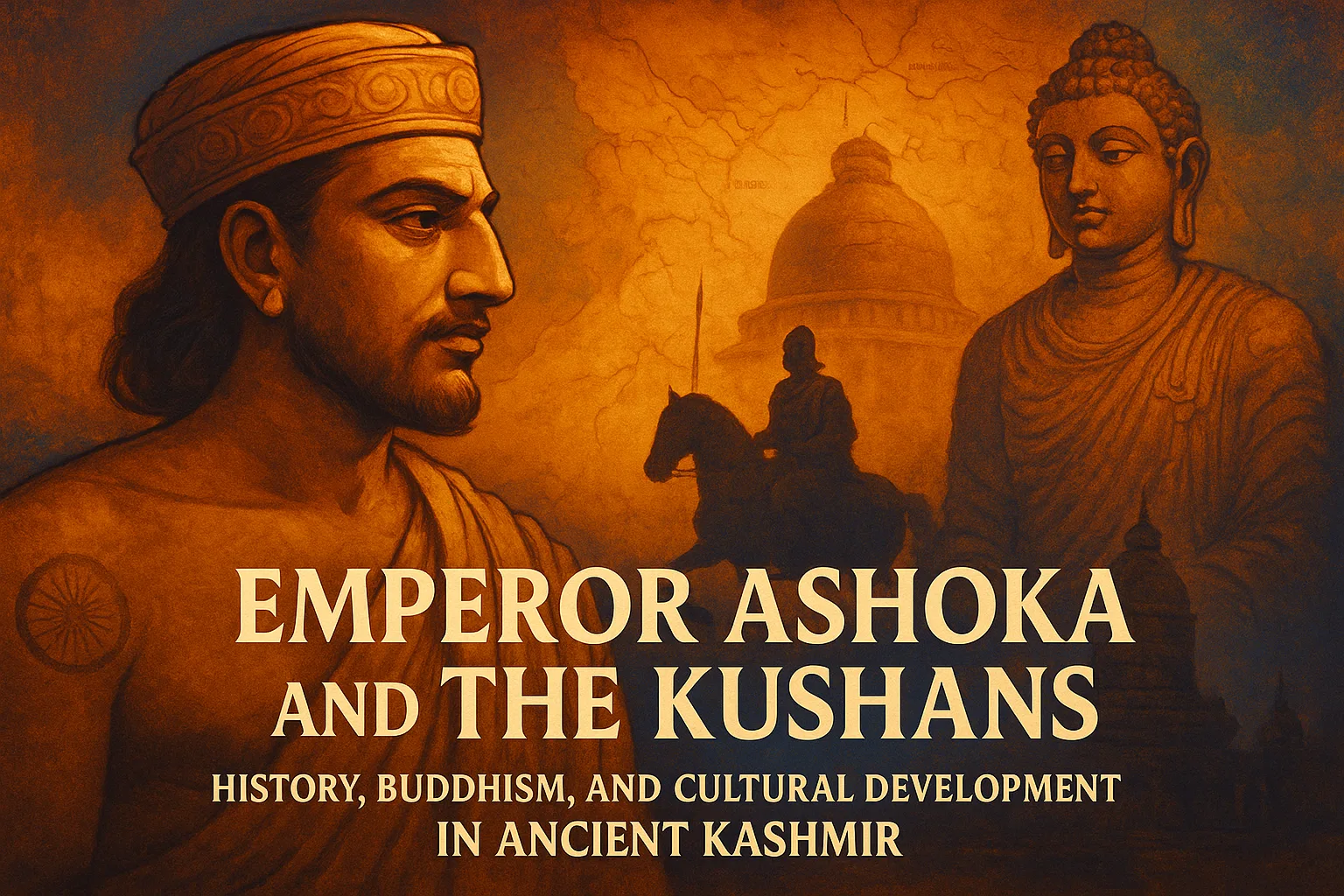
Ashoka is a landmark in Indian history. This greatest of India’s kings was the son of Bindusara and the grandson of the mighty Chandragupta, the founder of the Mauryan dynasty and the first creator of a united India. Ashoka ruled over a vast empire covering the whole of India except the extreme south. It included Kashmir as part of Ashoka’s dominions. Kashmir also formed a part of Ashoka’s territories. Kalhana presents Ashoka as a follower of the Buddha describing him as one who had ‘extinguished sin and spread righteousness.’
Ashoka’s Contribution to Kashmir
Buddhism and Shaivism flourished and developed side by side in Kashmir during Ashoka’s time and the emperor’s patronage gave it equal importance . Kalhana mentioned that Ashoka built two Shiva temples at Vijayesvara (now Bijbehara), and ordered several others renovated. In Vitastatra (Vethavatur) and at Shuskaletra (Hukhalatar) Emperor Ashoka built a number of viharas and stupas. He Sended Madhyantika for the propagation of Buddhism in Kashmir and Gandhara. Hiuen Tsang says that five hundred monks had taken up their residence in Kashmir in the time of Ashoka.
According to some Buddhist writers and scholoars tha include Taranatha, the Buddhist preacher Madhyantika Developed The saffron cultivation into Kashmir. It was Ashoka who founded the pre-historic city of Srinagri (now called Srinagar) in 250 BCE. Its ruins can still be seen at Pandrethan, (ancient Puranadhisthan) a location approximately 5 km from Srinagar on the Baramulla–Srinagar highway. He had the credit of establishing the International Buddhist Conference at Srinagri. Note that some historians identified Kalhana’s account of Emperor Ashoka as that of the 48th king of Kashmir dynasty.
Ashoka’s Successors and Decline of Buddhism
Ashoka died In 232 BCE and his son, Jaluka, was not Interested about Buddhism. But was a devotee of Lord Shiva. The hordes of Mlecchas (foreigners), who were probably Indo-Greek hordes and had—according to Kalhana—made incursions into the Valley. After a reign of sixty years, he was succeeded by Damodara, a descendant of Ashoka. He was also supporter Shaivism. Damodara, a city founded on a plateau in the vicinity of Srinagar, is still known by that name—it is presently the site of the Srinagar aerodrome. Buddhism continued to flourish in Kashmir despite the setback received by the loss of royal patronage. There was a revival of the faith during the reigns of Kushan (Indo-Scythian) kings.
THE KUSHANS
Under Kanishka (1st century CE) and his successors, the Kushan Kingdom reached its height. This empire was acknowledged as one of the four great Eurasian powers of its time (the others being China, Rome, and Parthia). The Kushans were Very Interersted in spreading Buddhism in Central Asia and China and in developing Mahayana Buddhism and the Gandhara School of Art In The ASian Continent.
Kushans and the Silk Route
Kushans were the best known rulers who controlled the famous Silk Route. This was an ancient highway, which was primarily used to transport silk from China to Rome and other countries. Kanishka linked Kashmir with the Silk Route. Kashmiri art items were also transported to west through this trade route. There are many places found in Jammu and Kashmir where Kushans lived. These are known as archaeological sites of Kushan emperor . These sites were found at many places like Harwan in Srinagar, Kanishkapura and Ushkar near Baramulla and Ambaran in Jammu district area.
Economic and Cultural Life during Kushan Period
The people during Kushan period cultivated wheat, barley and rice. Some of them were doing trade Activities artisans and craftsmenship . Craftsmen became famous during this period. They made many craft items of clay like terracotta (fired clay), tiles, small figurines, beads, seals etc. Clay tiles were found at Harwan and other places. These crafts found are mostly rectangular in shape. They are decorated by day-to-day life scenes of the population . Scenes show, stag, elephants, horse, birds, grapes, and flowers. The people during Kushan times used minted money. Coins Of Kushan Empire Were made of gold, silver and copper were found from many parts of Kashmir.
Kanishka’s Role in Spreading Buddhism
Kashmir came under the rule of Kushans during the reign of King Kanishka, son of Vima Kadphises. Kanishka became a Buddhist and under him Buddhism spread to Afghanistan and Turkey.
Fourth Buddhist Council
Fourth Buddhist Council in Kashmir was held at Kundalvan (modern day Harwan, near Shalimar Garden) in 72 CE. It was presided by Vasumitra, while Asvaghosa was his deputy. This council Led To The division Of the Buddhism into two sects—Mahayana and Hinayana.
Kushan Kings of Kashmir
Rajatarangini refers to three kings Hushka, Jushka and Kanishka as descendants of Turushka ruler. They built monasteries, Chaityas and similar other institutions. In fact, the towns of Kanishkpura, Huskapura and Juskapura (Kanispora, Uskura and Zukur) in Kashmir were founded by these rulers.